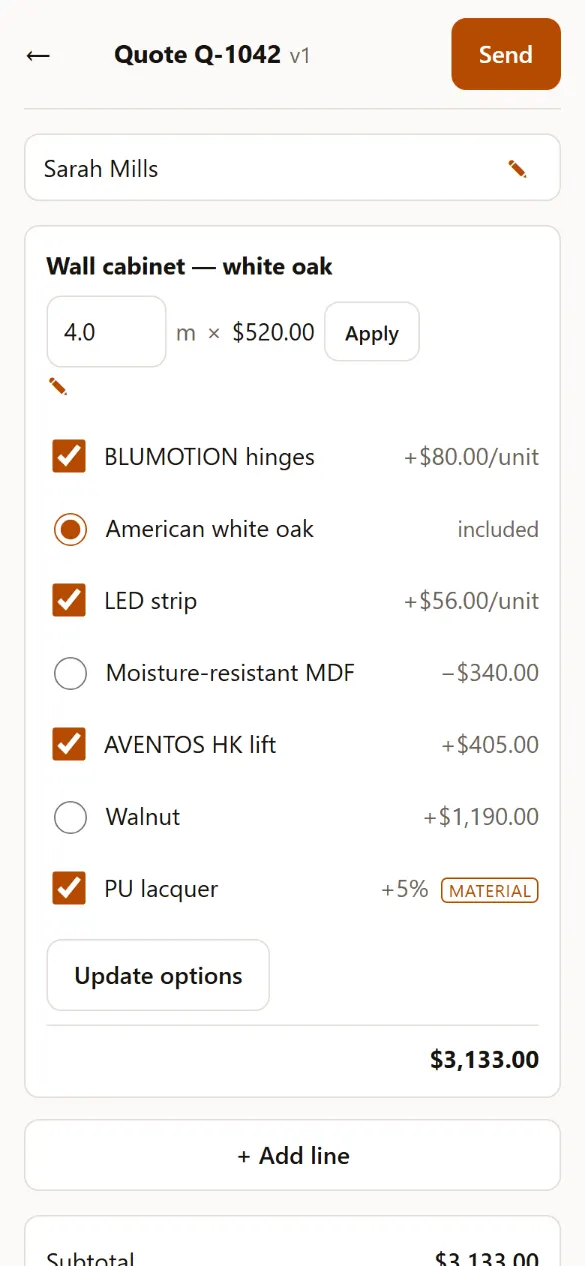
Your price list becomes a link. They open it, switch the material, adjust the size — the price moves while they watch. You get told the moment they do.
No customers, no revenue, no testimonials — and nothing on this page pretending otherwise. The demo below is the real thing: it runs the arithmetic the product will ship with, on prices taken from public supplier lists.
Left is what your customer sees. Right is your phone. Every notification on the right is caused by something you just did on the left — nothing is on a timer.
Your customer
You
Here is every step behind the total on the left phone. Punch it into the keypad. If your figure and mine agree, the page will say so — and that is the only place green appears on this page.
| Step | What happens | Amount |
|---|
Prices sit in the system, not in a spreadsheet one person owns and edits by hand. Two of your people quoting the same job produce the same number.
Change a material rate once and every quote after it follows. Nobody is working from last quarter's copy.
Off a shared spreadsheet these two numbers drift, and the customer is the one who notices.
Pick the item, send the link, done — on a phone, standing on the site with your hands dirty.
Most quotes are late because nobody wants to reopen the laptop at nine at night. Not because the spreadsheet is slow.
Raise your timber rate next month and last week's quote keeps its old figures, exactly as you sent them.
A customer reopening an old link sees what they were promised. Get this wrong once and you don't get the job — or the next one.
The quote keeps a copy of the prices, not a link to them.
Your price list, your materials, your options — set up once. After that a quote is four taps and a link.
No screenshot here: the alert isn't built yet. When it is, this is where the real one goes — not a drawing of one.
Whether they opened it, how long they stayed, which options they tried. That's the whole list. No location, no contacts, nothing else about them.
Don't ring up and say “I saw you looking at walnut twice.” They'll ask how you know, and from then on you're the person watching them.
Ring up and say “I've got a walnut offcut going cheap this week if you want to see it.” Same information. Completely different call.
Your name and your logo on the quote page — not ours. No account, no app, no form before the price. They tap the link and it's there.
Every option, every calculation, the live link — all of it. Our small badge sits at the bottom of the quote page.
Your logo, no badge, open-tracking and notifications, signatures. One user.
Everything above, plus per-person permissions, hiding cost prices from staff, and your own domain on the quote page.
The interactive options are in the free tier and always will be. They're the reason the product exists — putting them behind a paywall would mean free users never find out why it's any good.
These numbers aren't settled, because nobody has paid me yet and I don't know if they're right. Whatever the first users pay, they keep.
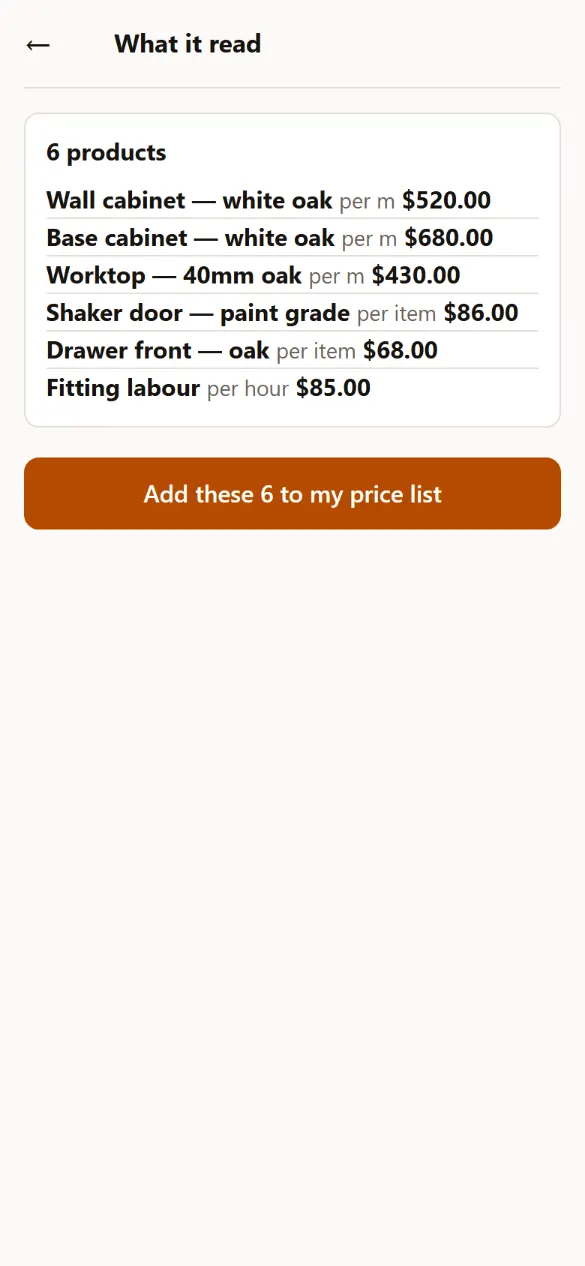
No. Drop your spreadsheet in and it reads the rows, then asks you which column is the name and which is the price. You fix it if it guessed wrong.
That part guesses, and I'll say so. The part that calculates never guesses — that's a fixed formula, which is the whole point of the section above.
Yes — like a shared document link. The link is 43 random characters so nobody guesses it, and search engines are blocked. But if your customer forwards it, whoever receives it can open it.
For bigger jobs you can add a 4-digit PIN and send it separately, and you can kill any link instantly.
It's evidence, not a certificate-backed digital signature. Strong enough for an ordinary commercial dispute: it locks the PDF, its checksum, the timestamp and what the customer did on the page.
For a large contract, still sign on paper. This is for closing quickly, not for replacing your contract. Anyone telling you otherwise is overselling.
Only if you switch it on per person, and only on the $50 tier. The block is enforced by the database, not hidden in the interface — so it holds even if someone goes looking with developer tools.
The customer-facing page never contains cost prices at all, including in the parts of the page you can't see.
No. Each business is walled off, and the wall is at the database layer.
To be straight with you: I can reach the data. I write the software and I run the servers — there is no way around that when it's one person. What I can do is log every access and let you read that log. Anyone claiming "our staff absolutely cannot see your data" either has a whole team and process behind it, or isn't being honest.
Export everything to a spreadsheet whenever you like, including after you stop paying. There's no feature that locks your data up to make you keep paying.
If I stop, you get at least 90 days' notice.
Send me the spreadsheet and I'll tell you straight whether it fits. If it doesn't, I'll say it doesn't.
And whatever the formula does, you can always type over any line by hand. Nothing is forced through the calculator.
The demo above runs the real arithmetic, and the two screenshots are of the running product — but nobody has paid for it and nobody has used it in a workshop. So the useful thing you can give me is the sentence where you stopped believing it.
Three things. Any one of them helps:
The button opens your mail app. Plenty of devices have none, and then it does nothing and says nothing — so here is the address in plain text: nguyennguyen16042004@gmail.com
Or just reply wherever you found this link — same to me, and other people get to read it too. This page sets no cookies, runs no analytics, and has no box to type into.
One message when there is something worth opening. Not a newsletter — there is nothing to send until then.
Same address if the button stays silent — nguyennguyen16042004@gmail.com, anything in the subject line will do.
The only thing this page ever asks you for is an address to tell you when it opens, and nothing else on here asks for one. If the demo was useful, or if I've got something wrong about how your trade actually prices work, one message is worth more to me than a signup. The corrections especially.
That button hands the address to whatever mail app this device has. If it has none, the button does nothing at all and gives no sign — so here is the address itself: nguyennguyen16042004@gmail.com
Demo figures are representative mid-market rates for a small shop, drawn from public supplier and trade price lists, converted to USD and rounded. They are not your prices — in the product, the prices are the ones you enter.
Careful with linear-metre cabinet pricing in particular: many published rates quote upper and lower runs together, and some average the two. The demo prices upper cabinets only.
Trysquare — demo build. This page sets no cookies, loads nothing from anyone else's server, and runs no analytics. It is a static file on a CDN, so there is no counter here and nothing that could count you. The only thing I ever hold is an address you chose to write to me from — kept on a list of its own, joined to nothing else, and deleted the day you ask.